Showing posts with label wool. Show all posts

Tuesday, 12 April 2011

Maker of the Month: Primoeza


Woodgrain scarf in charcoal ($159, available through COUNTER in ochre as well) and small shapes embroidered jumper ($255, exclusively available through the Primoeza shop)

The lovely Elizabeth Yong of Primoeza is our featured COUNTER maker this April!

Stay tuned for a mini visit to Elizabeth's studio! Coming soon on CLOG...

Friday, 9 April 2010

Introducing... Elizabeth Yong of PRIMOEZA

Autumn is upon us and what better way to embrace the season than through an interview with the wonderful Elizabeth Yong of knitwear label PRIMOEZA!

Elizabeth's delicate knits are all hand machine-knitted in her bayside studio and we've currently got a lovely selection of scarves and accessories awaiting your perusal here at COUNTER. But judging by Elizabeth's experiments, we can't wait to see what she comes up with for her next collection!

For more information, be sure to visit the PRIMOEZA website as well as Elizabeth's blog - it's a great read!

Happy Friday everyone, see you at Craft Hatch tomorrow!


How did your interest in textiles all begin?

Some of my earliest memories are of sleeping over at my best friend's house. Her family lived in a mansion-like house that was filled with antique wooden furniture, cracked leather chaise lounges, heavy, earthy tableware, crisp white cottons and English garden floral prints. I was so young but I had a real appreciation for those objects, the craftsmanship and the beautiful materials they were made from.

I don't know why I'm drawn to textiles in particular. I do notice though, that textile people seem to be quiet, introspective, love to travel and are appreciative of little details, which maybe describes me.


Could you please tell us about PRIMOEZA and how it all began?
Coming to set up my label has been a very long process. When I finished school, I put myself through many years of study, trying to find something I could apply myself to. I was very, very dissatisfied for so long but thank goodness, I finally had an epiphany and enrolled in the Studio Textiles course at RMIT.

Over a further five years of part time study, I worked my way through all the electives – weave, print, experimental textiles, but felt a real affinity for knit. I had never seen a knitting machine before, and it was a love/hate experience at first. The machines can be quite intimidating, noisy and grimy. I have always loved knit as a medium but I'm not much of a hand knitter so when I discovered what you can do with them, I was hooked.

Concurrently, I was working with a small business that imports the most luxurious fabric from Europe. This really fed me, showed me what amazing contemporary products you can make with traditional techniques, and the exposure educated my eye and feel for quality materials.

Ironically, I have not fully completed the Textiles diploma. It was a course that I thoroughly enjoyed, but I could feel it welling up inside that I was ready to go out and do my own thing. When I finally took the plunge I still needed a lot of encouragement from my partner and friends. I closed my eyes really tight and jumped!

One day I may have some of my pieces made at a knitting mill. You can do a lot on a big commercial machine that you can't do on a small hand operated machine and vice-versa. However, knitting up the samples is an integral part of my process and I can't imagine designing without being hands on the machine.


Some fabric samples


Being a fashion label, how important do you think it is to respond to current trends?
Trends can be used very constructively. They can open you to new ideas and ways of looking at things, doing things. On a practical level, they can make you more accessible. On the other hand I love designers who find an unoccupied niche and then go for it. Designers with a unique vision are usually the most inspiring.


Experimental pieces


What are some things that you draw inspiration from?
The environment has a huge impact on how I feel. My current apartment and workspace has nurtured me through a lot. It's a lovely place and there's lots of green around. The beach is at the end of the street. I'm very lucky.

For each collection thus far, I collect ideas, imagery and objects to help give the collection cohesion. My greater inspiration though is guided by a feeling of melancholy, nostalgia or whimsy and a strong sense of practicality and utility.


Whose work do you admire?
I love the textile patterns and colour palettes from the Art and Crafts and Art Nouveau periods.
The knitwear of Yohji Yamamoto. His pieces can be simultaneously rustic and naive yet contemporary and complex. The design teams behind the more textile driven fashion houses like Marni, Dries van Noten, Mina Perhonen, Eley Kishimoto and Mociun.

I'm becoming more and more interested in embroidery and stitching. I am finding a lot of work I like by young, contemporary designers like Susie Cowie.

Locally, I admire Nikki Gabriel and Katherine Bowman's work because it's just so beautiful, and to watch the set up and progress of textile printers Ink and Spindle on their blog has been fascinating.

But I admire of lot of people's work. I post these regularly on my blog.


More experimental pieces


What future plans do you have for PRIMOEZA?
I have a lot of dreams for PRIMOEZA. My next step is to start constructing garments. I'm a perfectionist though, so sampling will take me a bit of time. An important goal though is to enjoy what I have and not get too anxious about the future.

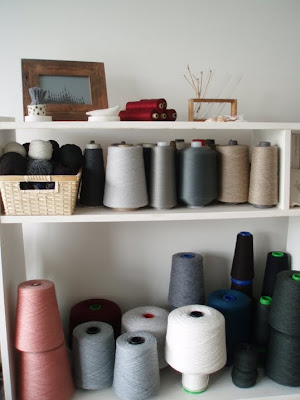
Elizabeth's workspace

Knitting machine


At last but not least, tell us a bit about your lovely cats. We hear that PRIMOEZA is a combination of their names!
Primo is a red Burmese. My partner and I had just came back from a trip to Italy and someone was looking for a home for him. I ran all the way to go and get him! His name means first in Italian. Ezra (or Eza) is a smokey black Devon Rex. He's way too smart for his own good. His name means helper in Hebrew and we got him because Primo was lonely on his own.

I was stuck for a label name for ages. I was trying to think of all these interesting names but I got sick of it and so started thinking about all the things that are dear to me. I had a joke with myself that I didn't want to call it after my partner so I'd name it after my pets!

People always ask me how to say it – it's PREE-MOE-ZA.

Sometimes I think those cats are actually goblins! There is always something happening. They are both remarkably clumsy and act like dogs. Ezra in particular loves craft and craft materials. His biggest adventure was going to the emergency room at midnight after he ate a lot of cotton and wool – he does admit that it wasn't one of his smarter decisions.

Friday, 13 November 2009

Introducing... Edwina Bolger

Edwina Bolger is one of COUNTER's niftiest knitters and today, CLOG is proud to feature her label LOOPE.

Since picking up knitting and sewing at the very, very tender age of five when most of us were still flinging dirt in the sandpit, what started out as a hobby turned into a career in 2006 when Edwina launched LOOPE. Naturally, Edwina uses only the best wool and wool blend yarns which she sources from Australia, Italy and the United Kingdom. Consisting of a range of baby accessories, toys and garments, as well as homewares and now womens scarves, LOOPE is a labour of love (and very nimble fingers too).

Happy Friday the 13th everyone! Ooohh superstitious... or should we say 'super-stitch-ous' (wow puns on CLOG just sank to a new low right there).

Quartet of LOOPE egg cosies

About life before and after LOOPE…
Life back then was somewhat different as it was pre-children. I slept a lot more! Since 1990 I have worked in private and public arts organisations and still do. As all artists know, never give up your day job! Knitting is something I have done since I was a young child and starting LOOPE followed on from my women’s label that I established in 2000. Launching LOOPE was something that had been brewing before I had my own kids, as many of my friends and family were always asking me to knit jumpers, blankets and toys for their little ones and so the seed was sown to launch my own range.

And about the name…
I wanted a name that was associated with the knitting process and knitting is making loops. I added the ‘e’ for my name and that was that!


Cotton pinafore

About the first thing I ever knitted…
I clearly remember the first real garment that I knitted. I was in grade three and it was a pale pink hug-me-tight (the precursor to the now trendy shrug!) in rib and garter stitch for little orphan babies. From then on I never really stopped. Certainly the whole process of knitting and the flexibility that the knit process allows, with the thousands of stitch designs and shaping techniques you can master keeps me constantly amazed and I am always learning.


About the tools of the trade…
I have always loved working with wool. It is such a fabulous and versatile material and advancements in yarn production over the years have produced stunning woollen yarns. Wool dyes extremely well and then there are the natural colours from black sheep as well to explore. No doubt many people grew up wearing scratchy uncomfortable woollen jumpers and so it had a bit of an image problem, especially for babies and children, but that has all changed now and woollen yarns are now incredibly soft and luxurious. Over the last couple of years I have moved towards using organic woollen and cotton yarns which are dyed using non-metal low impact dyes. I am committed to eco-friendly sustainable practices.

I don’t really have any nifty devices as such, but collecting vintage and retro knitting patterns and craft books is a passion! And indeed provides unlimited inspiration and laughs! Check out some of the photos – men looking very hip for the day, with hunting guns, cigarettes and brandy glass in hand! The hair-dos on some of the women – just amazing! Oh how times have changed! Apart from the laughs they are a great indication of the fashion of the time, not only clothes, but interiors, architecture and social mores of the day, due to the setting of the photo shoots. Oh and I would say a comfy chair is essential!

I did work from my Fitzroy studio for many years, but with young children to attend to I now have a tiny and overcrowded studio space at home. I hope to soon move out again, either that or my family do.


Teddy bear and hobby horse

What gets you in the mood to make?
I am always in the mood to make. As I said collecting old patterns certainly inspires me. Finding new yarns in a gorgeous colour palette is always very exciting and I am always trawling through online knitting shops and yarn producers all over the world looking for something new. Finding new yarn immediately makes me go for the knitting needles.


Neck warmer and cotton long-sleeve top
Ten years ago I was…
Working full time in a commercial contemporary art gallery in Melbourne and knitting on the side.

…and in ten years’ time I hope to be…
Definitely in a creative space, both mentally and physically. I hope that both my women’s and LOOPE label are going strong and that I have developed a loyal and appreciative following. Moreover I hope to see that the wider audience for all things bespoke has grown dramatically so that artists and crafts people like myself can earn an income from creating something truly special with skill, love and passion.

Chicken egg cosy

Friday, 9 October 2009

Introducing... Kyoko Osato

It's Friday again, and this week meet textile artist Kyoko Osato. Hailing from Japan, Kyoko is a master of felted wool and her delicate scarves, neckpieces and wraps mimic the soft movement of marine fauna such as seaweed and the like. Based in her home studio in Melbourne, Kyoko weaves on a floor loom and felts with a pair of trusty yellow gloves.

You may remember Kyoko's recent enCOUNTER exhibition Handwoven that took place earlier this year (click here to revisit it). We also have a whole range of Kyoko's scarves in stock at the moment and with the cold snap that's going on at the moment, you'll definitely be needing something warm and soft to snuggle up against.

Happy Friday everyone! See you at Craft Hatch tomorrow.


What prompted you to move to Melbourne to pursue Textile Design at RMIT?
I lived here a couple of times before I came to study at RMIT. Every time I live here, things go really well and I get a good vibe from everything Melbourne offers. When I was thinking what I could do to live in Melbourne, I found this Textile Designs course at RMIT. I applied and got accepted.

Why Melbourne?
I liked a photo of a tram, old green and yellow one, in a guide book when I first decided to come to Australia with a working holiday visa back in 1994.


After completing your studies you then moved to the UK for two years. What was that experience like?
I did some markets in London and Edinburgh. Not only people living in UK, but also people visiting UK from all over the world who visit markets. So many people gave me their honest feedback, all sorts of feedback, and told me if my work would fit into their own countries or not. For me, having a stall at a weekend market in London and at Edinburgh Fringe Festival were the best places to do some research. Living in UK for two years gave me a huge confidence in what I make and made me decide to be serious about it.

What brought you back to Melbourne?
From the beginning, I wasn't going to stay in UK for more than a few years. After staying there for two years, I was ready to come back to Melbourne to settle down and concentrate on my weaving business.

What encouraged your interest in textiles?
My mother is a dressmaker so I grew up with sewing machines and fabric. A fabric shop for me is like a bookshop for some people. I still spend hours in a fabric shop. Before I started studying at RMIT, I was more into making things on a sewing machine such as my own clothes and bags. I always liked textiles. When I learned how to weave at RMIT, I really enjoyed the whole process. In my second year at RMIT, I started using feltable wool for the first time for some of my weaving projects and slowly learned what I can do with the feltable wool combining with weaving techniques. I haven't stopped using it since. I try to use something else but I keep going back to feltable wool.

Could you tell us about your design approach and inspiration behind your work?
I tend to choose some organic names but I don't start from choosing a name or theme and start working towards it. I start from thinking about different weaving structures I can do on the loom and how they turn out after felting process. All my designs start from sampling and testing these structures. I always try to achieve something more than a flat piece of fabric which traditionally the weaving loom is used for.

I get inspired by shapes and abstract images found in natural objects. But I don't try to design towards them. I think the images stay at the back of my mind and when any of the samples meets the images, that's when a scarf is born and I give a name for it.

How do you think textiles is approached differently here in Australia in comparison with Japan?
It’s a difficult one to answer because I wasn't interested in the making side of textiles before I came to Australia. From what I can see, in Japan it looks like textiles influenced by the Japanese traditional style is still very strong, especially in weaving.


Tell us about your studio space…
My production work, weaving and felting, happens in the studio at the back of my house. We use it as a studio space but actually it's a garage. I share this studio with my housemate who is an artist. I weave and he paints, he's a great company to share the space with. Having this studio outside the house, even though it's only six steps away from the house, helps me focus when I am in there. Especially when I'm busy with orders, I pack a bag with enough materials to work with for a day, such as yarn, so that I don't need to go back into the house except when I make a cup of tea or lunch. I do my computer work and preparation for weaving in my bedroom which gets a lot of natural light.

How do you overcome creative obstacles?
Wait.
While waiting, do anything creative such as sewing and cooking to motivate myself or go through weaving books, pick a traditional weaving structure I've never tried before and weave it for fun.


And last but not least, out of all the designs you’ve ever made, is there a design that is particularly special for you?
The lattice scarf (pictured above, in 'seaweed'). I made this scarf for one of the projects at RMIT. Some people including teachers bought the scarf. This is also the scarf which was chosen to be used for the brochure image for the Scarf Festival 2004 at Craft Victoria. This scarf woke me up to what I do now and still keeps bringing in new smiles.

Thursday, 3 September 2009

Pom Pom making with Anita Cummins


Fresh from her exhibition at Mailbox 141 Pantone Pom Pom, textile artist and CVHQ Retail Ass.Man (hmm, we might have to rethink that abbreviation) Anita Cummins is now poised to revolutionise the world, one fluffy pom pom at a time!

In conjunction with the Victorian Tapestry Workshop, Anita will be facilitating a half-day workshop on the art of pom pom-making. The class will take place on Monday 21 September at VTW and bookings are now open.

Some information on the workshop:

In this half day workshop Anita will unlock the secrets of pom pom making. Using recycle cardboard and the gorgeous VTW yarn, Anita will guide people through making a pom pom pattern and provide inspiration for the many possible uses for these little cuties.

Pom pom makers will have the opportunity to utilise the VTW's 366 yarn colour range, and each person will have the opportunity to make at least two pom poms in the class.

And most importantly, here are the hard details:

What: Pom Pom Making with Anita Cummins
Where: Victorian Tapestry Workshop, 262-266 Park Street, South Melbourne
When: Monday 21 September, 1.30pm to 4.30pm
How much: $30 (!!!)
What do I do to book: Call Lily Fraser on 03 9699 7885 for enquiries, or fill out the form (pictured below)


Tuesday, 18 August 2009

PANTONE POM POM update


Have you seen Anita's updated pom pom installation at Mailbox 141? The new palette takes a turn towards creams, browns, greys and muted colours. Fabulous!

Because of the narrow format of Blogger, make sure you click the image below to be wow-ed by a panoramic view of Anita's installation.

If you haven't already, do have a read of a recent interview with Anita, and click here to view more images of Pantone Pom Pom. Anita will also be taking part at the upcoming Craft Hatch @ Melbourne Writers Festival market on Sunday 30 August, where she will have her scarves for sale with the option to embroider your initials on it. Kickin' it old school style!

Monday, 3 August 2009

Pantone Pom Pom by numbers...


You've seen the show and read the interview, so today CLOG is super proud to present Pantone Pom Pom-by-numbers... after all, the numbers don't lie!


760 pom poms

250+ hours

152 balls of wool

38 colours

15 metres of yarn per pom pom

13.68 kilometres of yarn

6 cracked and blistered fingers

a larger portion of the dvd’s at my local video store than I care to admit…

and of course,


countless puzzled expressions when forfeiting a night out to stay home and make pom poms…

Wednesday, 29 July 2009

Introducing... Anita Cummins


With Anita Cummins' exhibition Pantone Pom Pom almost at the half way mark now, there's never been a better time to shine the light on the life and work of fabulous lady herself.

We all know that Anita is one of the loveliest staff members here at CVHQ, but did you know that prior to her textile-based artistic practice, Anita worked as a freelance stylist? This totally explains her amazing wardrobe and keen eye!

Anita, who many of you will also know as CVHQ's ever-capable Assistant Retail Manager, is a budding textile artist who is particularly skilled in the art of the pom pom. For her exhibition Pantone Pom Pom (which is on at Mailbox 141 until 22 August), Anita has painstakingly wrapped, wound and trimmed over 700 pom poms in a myriad of colours and tones.

If you haven't already, take a peek at previous entries on Anita which includes photo documentation of Pantone Pom Pom.

Happy Friday everyone, see you at the launch of Craft Cubed tonight (from 6pm!)


About Pantone Pom Pom
I started making pom poms years ago for a university exhibition. I tried to make as many as I could in the university semester, which ended up being about 350. Back then they were all white with a few red ones. Making pom-poms developed into a bit of an obsession, and it became a sort of meditation for me.

Pantone Pom Pom was a natural progression for me. I have always been in awe of artists who use explosions of colour, but never had the guts to do it myself. I had started making pom poms in every colour I could find and then it dawned on me that I could really play with colour by referencing the pantone colour chart in response to the Craft Cubed theme of CITYCOUNTRY. I chose two colour palettes, a really bright, fluoro scale for city, followed by a really earthy, natural scale for country. That is not to say that these particular colours cannot appear in both urban and rural environments, but for the purpose of this project I wanted to celebrate colour gradations. A simplified response to the word city is bright lights and neon, while I think of the words neutral and natural in relation to country.


About the process…
It was pretty hard to find the colours I wanted, in the yarn that I wanted. Different types of yarn produced very different results, so I had to choose my colours according to what was available in the yarn that I like. I wanted to use only natural fibres, but there were some colours such as the fluoro green and orange that you can only get in acrylic fibre, so I did have to make a few exceptions. My Gran thinks it is a shame to waste all that beautiful wool on making pom poms, but wool really does produce the best results. It would also be great to dye my own colours, but I have no experience in dyeing, so perhaps that’s something I need to try in the future.

I would often take my stuff to my mum’s and make pom poms in her lounge room. On a number of occasions her wayward dog Louis stole a pom pom that had rolled onto the floor, snuck under the couch with it and proceeded to ‘kill’ it. It was funny but annoying…

Five years’ ago I was…
I was studying Creative Arts and Arts at The University of Melbourne. I drank a lot of coffee, smoked a lot of cigarettes and wrote some very unworthy essays. I dabbled in all of the creative arts, my favourites being life drawing and photography, mainly because of my lecturer Barb. I majored in Italian, which was by far my worst subject but I scraped through and even ended up living in Italy for a semester. I saved up my pennies and travelled in South East Asia over summer.

…and in five years’ time I hope to be…
I don’t like to think too far into the future. I am not a career-focused person. I just want to keep doing things that I love and be open to any opportunities that may arise as a result of that.


A selection of Anita's scarves available at COUNTER

About making the move from being a stylist to textiles as an artistic practice…
I love fashion and photography, so styling seemed perfect for me. I should have known that nothing is as it seems. I really enjoyed working with all these creative people who were beginning to forge their careers as photographers and make-up artists and models, but a lot of these jobs were unpaid. The jobs that paid well were really boring, less about being creative and much more about being super-organized and getting everything done as fast as possible. I also stopped getting excited about putting outfits together, which is a bit of a disaster if you want to be a stylist. So I stopped.

Now I have time to say yes to opportunities that arise and put my own artistic practice as a priority. I get so much enjoyment from ‘creating’ and since making the decision to focus on my own stuff everything is just falling into place. And I am starting to get excited about fashion again…


My dream collaboration would involve…
I think Yoko Ono is a brilliant artist. I saw one of her exhibitions in Barcelona about 5 years ago and I have never forgotten it. The gallery was massive with about twenty rooms and in each room was an instruction. She orchestrated it so that her audience was a vital ingredient in the creation of the work. It gave even the most unlikely candidate a chance at being creative. She is so whimsical and particularly generous with her audience – allowing them to participate in her artworks. I think I would find it really hard to give over control to someone else but I would love to learn from someone like Yoko.

Having said that, I don’t really think about collaborating. It’s something that just seems to happen when two artists are inspired by each other and living in the same city.

I’m really looking forward to…
The Victorian Tapestry Workshop has asked me to share my love of the humble pom pom with others by giving classes. It is something anyone can do for not much money.

Tune in to SYN FM on Sunday for their Arts Mitten program from 3 to 4pm to hear Anita and Joe Pascoe (CVHQ Chief) talk about Craft Cubed and the exhibitions involved! Exciting stuff. We can't wait!

Monday, 20 July 2009

Pom poms fit for the Pompidou*


Following on from the last post we did of the installation of Anita Cummins' exhibition Pantone Pom Pom, here are some shots of the finished exhibition as well as some happy snaps from the opening night.


Pantone Pom Pom consists of two colour palettes: an exuberantly bright one and a more sombre, tonal palette. The changeover to the muted palette will take place from 1 August onwards, with the exhibition coming to a close on 22 August.

Click here to view more images of Anita's exhibition.


*Today's pun-tastic title is courtesy of CVHQ's official photographer Alexia Skok. Thanks Alexia! Skilled and funny! What a package.

Friday, 10 July 2009

Introducing... Alana Clifton-Cunningham

This week CLOG is proud to feature current Gallery 3 exhibitor Alana Clifton-Cunningham, knitter extraordinaire. Based in Sydney where she lectures in Fashion at the University of Technology, Sydney, Alana's artistic practice is an exploration of contemporary knitting, in particular the idea of how knitting is able to deconstruct notions of traditional knitting patterns for the body.

Alana's work is a fantastic display of not only the tactile nature of knitwear, but its sculptural ability as well. Wool is puckered and tightened to create manipulate the surface of the garment, creating a wonderful 3D effect that invites you to touch (well some of them anyway, the other garments are hands off!)

Without further ado, presenting Alana Clifton-Cunningham.

Happy Friday everyone, and see you tomorrow at Craft Hatch at the City Library!

Stomach wrap

About the first time I picked up a pair of knitting needles...
The first time I picked up a pair of knitting needles was when I was about 16 at school, but I quickly put them down again! The second time was at university; knitting was a compulsory component of the degree course where we learnt both hand and machine knitting (using a domestic knitting machine, so very hands on!) The first couple of attempts at knitting at uni were also a bit disastrous, insofar as the knitting would fall off the machine when you were almost at the end etc.

The first thing I made was...
The first thing I recall making at school was a knitted jumper. The first thing I recall making at uni was a knitted vest – very avant-garde in black and white! It was cut away under the bust, skin tight to the hip. From here I continued to explore knitting and majored in it for my final fourth year project. I created a resort wear collection inspired by the travelling circus, so it was quite colourful, with influences of theatrics.

Legwrap and muff

Please describe how you developed and refined your amazing knitting machine skills...
I think I was determined to conquer knitting, so I just kept at it, and before long, I really understood the fundamentals. I was always intrigued by the qualities of knitting, so I guess that helped me to strive to refine it. It also helped when I purchased a knitting machine for home, this gave me the time I needed to practise and develop interesting stitches and outcomes. So yes it was frustrating at first, but became a passion through practice and determination!

Could you please expand upon how body scarification is explored in Visible Markings?
I am interested in identity, and I suppose working with the concept of scarification and knitting, I found the two worked really well together. Knitting conveys so many messages through the stitch patterning and structure, very similar to body scarification, so I liked the idea of combining the two to create a new language. Some of the pieces that I have created for the exhibition look at the concept of knitting as a protective cocoon, other pieces rely comfort, or sexual maturity.

While I have used traditional stitches in some of the pieces, I have tried to reconfigure them through how they have been worked within the piece. Two types of traditional knitting I am particular interested in is Aran and Guernsey knitting.

For Aran knitting, the symbolic nature of the stitch patterns that feature within each sweater can vary from family to family. The amount of patterning that is knitted within an Aran sweater represents the number of males within a particular family group. On a male marriage into a family, the ornate textural pattern for the new member would feature down the centre front of the garment. After the birth of the first son, the design would widen with panels featuring addition design work to signify the expanding family unit. The patterns and motifs were inspired by Celtic metalwork, and is very three dimensional and sculptural in quality, with the patterns being symbolic and tell a story of everyday life.

With Guernsey and Jersey knitting (as known as a ‘fisherman’s’ pullover) the symbolic references of the stitch patterning reflect life by the sea. The coastal villages, which were mostly fishing villages, utilised patterns and motifs designed to represent seascapes and sea-life such as starfish, waves, beach pebbles, ropes, fishing nets, and diamond patterns that were used to promote success and wealth.

It is believed that each fishing village or coastal town developed its own style of stitch pattern and motif. This was used not only to distinguish the locality of the village itself, but the patterns also helped to identify the bodies of drowned fisherman found at sea. Initials of the wearer were often embedded into the background of the knitted garment for easy identification.

The elaborate patterns also indicated social status. Because individual families kept the same patterns and the village had few distinctive designs. The fisherman’s ‘gansey’ became a symbol of belonging. Stitch patterns such as anchor, cables, diamond, flags, herringbone, moss stitch, rope ladder and shells were combined in significant ways. The stitch patterns and their combinations was often the knitter’s interpretation of significant things in a fisherman’s life – his tools, his livelihood and the weather etc.

Shoulder wrap

How do you think wearability, functionality and aesthetics play out in Visible Markings?
All of the pieces created are wearable to some degree. What I was hoping to achieve by creating the pieces was challenge how fashion has been traditionally been viewed on the body. I am interested in components of fashion, such as gloves, neck and shoulder pieces etc, rather than whole garments. I guess this all ties in with the research that I have undertaken regarding the perceptions of knitting and how is should work on the body. It is interesting that a lot of people still view knitting as something that should be completely function (wearable) and offer protection and comfort. I do try to think of all the pieces individually and how they will work on the body, plus the messages that they can convey, but I suppose there are more pieces that say a lot more than others, such as arm sling (pictured below).

Arm sling

Who inspires you?
I am inspired by artists such as Caroline Broadhead who works with knitting as a medium. Her work utilises a variety of materials such as human hair etc. to create messages that repulse, but also intriguing. Liz Collins is another designer who I admire. Her work involves knit and fabric together and plays with process of shrinkage. The technique of making that she uses allows her to combine a variety of textures and weights which challenge the silhouette and how a garment works on the body.

Another reference is Rei Kawakubo (Comme des Garçons), while her work is not always knitted, I am fascinated with how she deconstructs the notions of fashion and how garments should be seen on the body. Vivienne Westwood also always challenges knit. She has a fascinating way of borrowing traditional stitch patterns and reinventing them, such as Argyle knit.

Neck pods

What is your favourite yarn to work with, and do you have a favoured technique of knitting?
I enjoy working with Australian wool. It has these amazing qualities in that you can mould it, manipulate it. Knitting with wool on a knitting machine is enjoyable, as it can be distorted/manipulated as you knit. You can adjust the tension, transfer stitches, catch stitches, drop stitches, and due to the slight elasticised quality, can be steamed after kitting and manipulated in/or out of shape.

Knitting the tucks as in the neck pods (pictured above) is an interesting process. It involves endless counting of stitches, catching them up to make the tuck and 'short row' knitting (which is a method of partially knitting an area of a garment, such as what you see in socks -heels and toes). All the pieces are fully fashioned, and the process that I go through to design and make the pieces, involves firstly draping knitted lengths of cloth on a mannequin. From here I manipulate and cut it away to form a shape or silhouette, and then once I have what is referred to as a toile, I then can created the paper knit patterns, which I draft on graph paper to scale.

So the process of making can be very time consuming, especially since I still work by hand. Some of the pieces I sometimes machine knit, and will also create a hand knitted version. It is interesting seeing the differences, just using a different process of making.Machine knitting tends to be quite even, while hand knitting, can be a bit more uneven and a bit softer to handle.

Collar

And finally, what is your idea of a perfect setting for knitting?
Anytime I have free time is great for knitting! I generally work from home and set the knitting machine up in the kitchen so I see everything that is going on! I do need a clear space and head to knit, but enjoy knitting at any time of the day or evening. I do like to start and finish a project, rather than have multiple projects on the go, this way, I can solely focus on making the one pieces, without becoming too influences by other ideas or techniques.

Alana's exhibition is on in Gallery 3 until Saturday 25 August.

To view more images of her exhibition Visible Markings, click here.