The lovely and very articulate Daniel Neville, author of The Theory of Nevolution blog has written a most wonderfully insightful review of CVHQ's current exhibition roster featuring Simon Lloyd, Natasha Dusenjko and Liz Low.
Do have a read! It's really very good. Thank you very much for this review Daniel.
In other news, Karen of Melbourne Jeweller blog dropped by CVHQ sometime last week to say hello, talk blogs and visit the exhibition (of course). Karen has also reviewed Natasha's exhibition babel and it too is another splendid read.
As we all know, good things come in threes and Soren from Buro North design studio has also written a post about babel in the Buro North blog.
Be sure to check these blogs out. It's always lovely to read about ahem, yourself isn't it?
And we promise there weren't any bribes involved... we swear!

Showing posts with label Natasha Dusenjko. Show all posts
Showing posts with label Natasha Dusenjko. Show all posts
Thursday, 4 June 2009


Tuesday, 2 June 2009
Natasha Dusenjko @ COUNTER
 Currently in COUNTER at the moment are some lovely paper necklaces by Gallery 2 exhibitor Natasha Dusenjko.
They come in 3 lengths - 290mm, 600mm and 680mm - and are priced between $85 and $155.
 You know you want one...
 Friday, 29 May 2009
Introducing... Natasha Dusenjko
Today CLOG is excited to present an interview with current Gallery 2 exhibitor Natasha Dusenjko. Featuring delicate porcelain spindles with lines of paper wrapped around them, Natasha's exhibition Babel is a show that you must have a look at up close.
Babel follows on from Natasha's word-based ceramic work Bone Ancestor II that was accepted as a finalist in the 2009 Manningham Ceramic Art Award.


Initially you started studying graphic design before changing your focus to ceramics. How did this affect the way you approached ceramics?
I have a background in graphic design and printmaking, even though I enjoyed working within these areas, I was also becoming frustrated with flat surfaces and had a real desire to work on a more sculptural level. I would find myself cutting up prints and folding them into objects and packages. My hands needed to get busy in an entirely new way. Sculptural work provides an intricate tactile process. In regards to ceramics, the lack of knowledge relating to its technical processes has allowed a particular kind of freedom. The ability to concentrate on the conceptual aspect of my work, without the potential hindrance which an overt technical knowledge may have created. I think this is an important factor relating to the direction in which my work has evolved. The marriage between various disciplines which have formed my training in art and design, is becoming more apparent in my work.
Do you think Babel is the final evolution of your exploration, or do you hope to continue working on it in the future?
I don’t think there will ever be a final evolution of my exploration! Each work that approaches resolution, re-opens enquiry anew. I am looking forward to beginning a new project, and the possibility of a new text arising out of that process, its point of departure will be Babel.
Could you please tell us about the technical side of creating the works in Babel. It must have been quite time consuming, given their small size!
There are various different aspects in the making of this work. Map 1 and Chart 2 were created in a program called Indesign. Both the layout and Black & White palette are influenced by ancient star charts. I did begin with an idea about how to create these charts, but it is often the mistakes and discoveries that only happen in the making that determine the final result. This is an aspect of the work I really enjoy. The layout of the text and graphics which would later be sliced and rolled, were also created in this way.
The sculptural aspect incorporates two processes. The first, involves sculpting the bones from porcelain. I am not, at any stage sculpting towards any definite or predetermined form. Rather, the form emerges through a playful process, allowing an intuitive conversation to occur between the material and myself. After a period of time, my fingers become fluent with both the nature of porcelain, and these bone-like forms. Alternately, the long thin spines are created by simply rolling the porcelain into ‘snakes’. This is a very child-like motion, but also requires a sensitivity and control in order that the porcelain doesn’t dry out and crack. After firing, all these pieces are individually polished using various grades of sandpaper.
The second, involves intricate work and is much more time-consuming. This process involves slicing up lines or slabs of printed text and then rolling these strips of paper around the porcelain bones. Each individual form is built up by the continual layering of these paper scrolls. Every Babelbone and Tower is an exercise in composition and balance. As always, some are more satisfactory than others!
The wall installation, unknown architect (pictured below), features 196 individual small paper scrolls. The codes are directly transferred onto the wall using Letraset.
And yes, it has been a very busy 6 months!

What has been your proudest achievement so far?
The exhibition of my latest work Babel, currently showing here at Craft Victoria. I think Babel is my most articulate work.

And finally, what would your dream collaboration entail?
Sound, definitely. Sound and light. I have been interested in working with a sound artist for some time. Sound has the power to conjure on a completely different level; it can be a very physical experience.
In terms of an artist, I immediately think of Patti Smith. Her words, music and poetry have definitely been an inspiring influence. I respect the intensity in Patti Smith’s work. The reckless beauty, passion and visionary relationship with what I would describe as the Muse. Her installation The Coral Sea at Anna Schwartz Gallery (2008 Melbourne International Arts Festival) was particularly moving; I was enveloped and mesmerised by the visceral sounds and dark liquid imagery.


Babel follows on from Natasha's word-based ceramic work Bone Ancestor II that was accepted as a finalist in the 2009 Manningham Ceramic Art Award.


In your artist talk you mentioned that Babel is an edited version of bone ancestor II. Could you tell us a bit about this?
Babel is very much related to my earlier work bone ancestor II, therefore it made sense to build upon the textual concepts of that particular work, expanding on the sensibilities of forbidden or buried texts. I have consistently worked with concepts which are interrelated, so there is a definite relationship from one work to the next. Editing the text would make it new again. It was also an experiment in how much it could be chopped up and deconstructed, yet still contain it’s original core.
You've used text from The Material Poem – is there a special reason behind this?
I find there is a refining process from one project to the next, therefore an opportunity to gain a deeper understanding of the themes and concepts. The work included in The Material Poem is titled bone ancestor. bone ancestor II was exhibited a year after publication of The Material Poem. Although this exhibition would feature the same sculptural works, it was a physical exhibition rather than pages in a book. This presented an opportunity to expand on the text already included in The Material Poem. bone ancestor II was approached in a way that would allow new text and graphics to provide an alternate context for the ceramic objects.
The Material Poem, edited by James Stuart, is an e-anthology of text-based art and inter-media writing, which is now also available as a printed publication. http://www.nongeneric.net/
Babel is very much related to my earlier work bone ancestor II, therefore it made sense to build upon the textual concepts of that particular work, expanding on the sensibilities of forbidden or buried texts. I have consistently worked with concepts which are interrelated, so there is a definite relationship from one work to the next. Editing the text would make it new again. It was also an experiment in how much it could be chopped up and deconstructed, yet still contain it’s original core.
You've used text from The Material Poem – is there a special reason behind this?
I find there is a refining process from one project to the next, therefore an opportunity to gain a deeper understanding of the themes and concepts. The work included in The Material Poem is titled bone ancestor. bone ancestor II was exhibited a year after publication of The Material Poem. Although this exhibition would feature the same sculptural works, it was a physical exhibition rather than pages in a book. This presented an opportunity to expand on the text already included in The Material Poem. bone ancestor II was approached in a way that would allow new text and graphics to provide an alternate context for the ceramic objects.
The Material Poem, edited by James Stuart, is an e-anthology of text-based art and inter-media writing, which is now also available as a printed publication. http://www.nongeneric.net/
Initially you started studying graphic design before changing your focus to ceramics. How did this affect the way you approached ceramics?
I have a background in graphic design and printmaking, even though I enjoyed working within these areas, I was also becoming frustrated with flat surfaces and had a real desire to work on a more sculptural level. I would find myself cutting up prints and folding them into objects and packages. My hands needed to get busy in an entirely new way. Sculptural work provides an intricate tactile process. In regards to ceramics, the lack of knowledge relating to its technical processes has allowed a particular kind of freedom. The ability to concentrate on the conceptual aspect of my work, without the potential hindrance which an overt technical knowledge may have created. I think this is an important factor relating to the direction in which my work has evolved. The marriage between various disciplines which have formed my training in art and design, is becoming more apparent in my work.
Do you think Babel is the final evolution of your exploration, or do you hope to continue working on it in the future?
I don’t think there will ever be a final evolution of my exploration! Each work that approaches resolution, re-opens enquiry anew. I am looking forward to beginning a new project, and the possibility of a new text arising out of that process, its point of departure will be Babel.
Could you please tell us about the technical side of creating the works in Babel. It must have been quite time consuming, given their small size!
There are various different aspects in the making of this work. Map 1 and Chart 2 were created in a program called Indesign. Both the layout and Black & White palette are influenced by ancient star charts. I did begin with an idea about how to create these charts, but it is often the mistakes and discoveries that only happen in the making that determine the final result. This is an aspect of the work I really enjoy. The layout of the text and graphics which would later be sliced and rolled, were also created in this way.
The sculptural aspect incorporates two processes. The first, involves sculpting the bones from porcelain. I am not, at any stage sculpting towards any definite or predetermined form. Rather, the form emerges through a playful process, allowing an intuitive conversation to occur between the material and myself. After a period of time, my fingers become fluent with both the nature of porcelain, and these bone-like forms. Alternately, the long thin spines are created by simply rolling the porcelain into ‘snakes’. This is a very child-like motion, but also requires a sensitivity and control in order that the porcelain doesn’t dry out and crack. After firing, all these pieces are individually polished using various grades of sandpaper.
The second, involves intricate work and is much more time-consuming. This process involves slicing up lines or slabs of printed text and then rolling these strips of paper around the porcelain bones. Each individual form is built up by the continual layering of these paper scrolls. Every Babelbone and Tower is an exercise in composition and balance. As always, some are more satisfactory than others!
The wall installation, unknown architect (pictured below), features 196 individual small paper scrolls. The codes are directly transferred onto the wall using Letraset.
And yes, it has been a very busy 6 months!
What has been your proudest achievement so far?
The exhibition of my latest work Babel, currently showing here at Craft Victoria. I think Babel is my most articulate work.
And finally, what would your dream collaboration entail?
Sound, definitely. Sound and light. I have been interested in working with a sound artist for some time. Sound has the power to conjure on a completely different level; it can be a very physical experience.
In terms of an artist, I immediately think of Patti Smith. Her words, music and poetry have definitely been an inspiring influence. I respect the intensity in Patti Smith’s work. The reckless beauty, passion and visionary relationship with what I would describe as the Muse. Her installation The Coral Sea at Anna Schwartz Gallery (2008 Melbourne International Arts Festival) was particularly moving; I was enveloped and mesmerised by the visceral sounds and dark liquid imagery.
To view more images of Natasha's exhibition Babel, click here. For an excellent article about the exhibition written by Natasha and published in the May issue of Trouble magazine, click here.
Babel will be on show in Gallery 2 until 13 June.
Wednesday, 13 May 2009
babel
To blow those mid-week blues away, here's a peek at Natasha Dusenjko's Gallery 2 exhibition babel, currently on until 13 June.
Babel is a word-based collection of fine porcelain and paper works. This collection of short texts constitutes a series of incantations, codes and instructions scrolled around porcelain bones or thin spines. The porcelain bones are internal structures and vessels of ancestor memory. This memory is fluid, is evasive, is aquatic. The thin spines resemble futuristic Towers of Babel reaching into space, anticipating communication and new frontiers. These towers have either an upright or collapsed form.
In the making, both forms build toward new possibility, words become obscured, resulting in a non-defined beginning or end, now replaced by chance permutations of the accumulated text. The sculptural works are deliberately placed onto two large scale text based charts. Each chart is placed on a raised surface, analogous to work benches in an observatory or laboratory suggesting a process of decipherment. Map 1 exhibits a similarity to ancient star charts, the placement of towers alluding to significant points of a constellation. The accompanying Chart 2 resembles an organised series of archeological artefacts, each piece methodically numbered and labelled.
Ultimately, Babel evokes a spiral passage both outward and inward. To unravel the scrolls initiates a return to the spine – the axis mundi, the source of a universal native tongue – love.


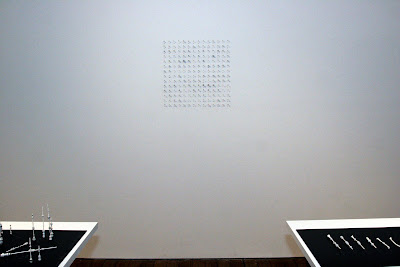


Babel is a word-based collection of fine porcelain and paper works. This collection of short texts constitutes a series of incantations, codes and instructions scrolled around porcelain bones or thin spines. The porcelain bones are internal structures and vessels of ancestor memory. This memory is fluid, is evasive, is aquatic. The thin spines resemble futuristic Towers of Babel reaching into space, anticipating communication and new frontiers. These towers have either an upright or collapsed form.
In the making, both forms build toward new possibility, words become obscured, resulting in a non-defined beginning or end, now replaced by chance permutations of the accumulated text. The sculptural works are deliberately placed onto two large scale text based charts. Each chart is placed on a raised surface, analogous to work benches in an observatory or laboratory suggesting a process of decipherment. Map 1 exhibits a similarity to ancient star charts, the placement of towers alluding to significant points of a constellation. The accompanying Chart 2 resembles an organised series of archeological artefacts, each piece methodically numbered and labelled.
Ultimately, Babel evokes a spiral passage both outward and inward. To unravel the scrolls initiates a return to the spine – the axis mundi, the source of a universal native tongue – love.


Coming up soon, an Introducing... featuring Natasha! We'll also be posting more images of the show towards the end of her exhibition.
Wednesday, 6 May 2009
Opening night
Last Thursday evening we welcomed our fresh new exhibition program featuring work by Simon Lloyd in gallery 1, Natasha Dusenjko in gallery 2 and Liz Low in gallery 3. It was a lovely affair (and well-lubricated too!) and was well attended by fans, friends and family.

 As mentioned earlier, drop by Gallery 3 from Tuesday to Friday between 11am and 3pm and between 12pm and 2pm on Saturdays to watch Liz in action. Till 31 May, Liz will be crafting ceramic work that mirrors the 3 finished works on display in Gallery 3. Upon their completion, Liz will be hosting a 'Water Pouring Ceremony' on Thursday 2 June at 6pm to celebrate the subsequent erosion of the works. Very poetic indeed!
 Simon Lloyd, who will be presenting a floor talk on Friday 22 May at 2pm.

 Nella Themelios and Natasha Dusenjko during Natasha's artist talk.

We'll have more images of each exhibition on CLOG soon, so keep checking over the next week!
Photo credit: Alexia Skok. Thanks Alexia!

 As mentioned earlier, drop by Gallery 3 from Tuesday to Friday between 11am and 3pm and between 12pm and 2pm on Saturdays to watch Liz in action. Till 31 May, Liz will be crafting ceramic work that mirrors the 3 finished works on display in Gallery 3. Upon their completion, Liz will be hosting a 'Water Pouring Ceremony' on Thursday 2 June at 6pm to celebrate the subsequent erosion of the works. Very poetic indeed!
 Simon Lloyd, who will be presenting a floor talk on Friday 22 May at 2pm.
Liz Low looking resplendent in buttercup yellow.
 Nella Themelios and Natasha Dusenjko during Natasha's artist talk.
We'll have more images of each exhibition on CLOG soon, so keep checking over the next week!
Photo credit: Alexia Skok. Thanks Alexia!
Thursday, 30 April 2009
Exhibition opening tonight!
Put on your best clothes and come join with us in welcoming our latest exhibition program featuring the work of Simon Lloyd, Natasha Dusenjko and Liz Low. Artist talks commence at 5.30pm, with the exhibition officially open from 6pm.
We have a few surprises up our sleeve with these exhibitions, including a daily (okay okay, it's really Tuesday to Saturday) visit by ceramacist Liz Low for the first few weeks of the exhibition. Liz will be crafting for several hours a day and CLOG will be faithfully recording the process via daily updates. More information on this will be available soon!
For now, here are some 'before' shots:


See you this evening for an evening of happy revelling and perhaps even a glass of wine or 5!
We have a few surprises up our sleeve with these exhibitions, including a daily (okay okay, it's really Tuesday to Saturday) visit by ceramacist Liz Low for the first few weeks of the exhibition. Liz will be crafting for several hours a day and CLOG will be faithfully recording the process via daily updates. More information on this will be available soon!
For now, here are some 'before' shots:

Simon Lloyd Gleaning Potential
Natasha Dusenjko Babel
Liz Low cycle
See you this evening for an evening of happy revelling and perhaps even a glass of wine or 5!
Subscribe to:
Posts (Atom)