Showing posts with label Nathan Gray. Show all posts

Monday, 19 October 2009

Attack Decay Sustain Release

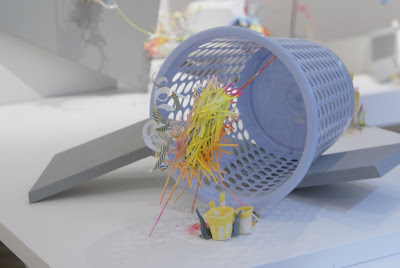
Now that Nathan's show has come and gone, here are some images from his exhibition to help you remember the good times.


We may have run out of hard copies of the accompanying exhibition catalogue, but you can still download it off our website
.

Still want more? Click here to read an interview between Nathan and Kim (Craft Victoria)


To view more images of the show and also of last Thursday's closing performances by The French and Free Choice Duo, click here.

We hope you managed to catch this wonderful show! Our next round of exhibitions opens this Thursday evening at 6pm, details are on the sidebar.


Photography by Esther Van Doornum.

Friday, 16 October 2009

Thanks everyone


A big thank you to all who came to last night performance/closing party, there was a great turnout and we couldn't have had a more fitting end to Nathan's exhibition.


A special thank you to Jess and Jarrod of Free Choice Duo for playing last night, to Esther for taking photos, and most of all a big thank you to Sam our cleaner for making all those beer bottles disappear (strange because we weren't serving drinks last night - where there's a will there's a way...)

Free Choice Duo


The French

Photos of Nathan's show will be up soon. Hold tight!


Photography by Kim Brockett

Wednesday, 14 October 2009

Closing party featuring The French & Free Choice Duo


Awesome poster by N Gray


When you're done doing the exhibition opening rounds tomorrow evening, come by Craft Victoria at 8pm for special "anti-drone" performances by The French (playing their second ever show!) and Free Choice Duo (playing their umpteenth opening/closing show - that's a good thing!)

Just so you know, The French are: Nathan Gray (Snawklor, Vortices), Julie Burleigh (Solo, Session musician with Beaches, Mum Smokes etc.) and Bianca Hester (Paeces) and Free Choice Duo are: Jarrod Zlatic (Fabulous Diamonds) and Jessica McElhinney (Troglodyte's Ball).

Click here to go to the Facebook event page for more info.

It'll be a great way to wrap things up for the final week of Nathan's exhibition and we hope you can make it to the closing party.

PS. It was in Three Thousand this week so it's got some cred (right Nathan?!)

In the meantime, to whet your appetite here are some videos of Nathan. The first is an excerpt of a performance with Dylan Martorell that took place earlier this year at Tape Projects in Carlton, and the second is Tudo Que Acho (Everything I Find/Feel), a video produced by Nathan during his residency in Bahia, Brazil.

See you tomorrow!


Tuesday, 13 October 2009

A two-way with Mr Gray

For today, here's an excerpt of a super-special interview between Nathan and CV's Kim Brockett that was conducted (for the first time) via Skype. Ah technology, bringing everyone closer together without the awkwardness of real-life interaction...

I know interviews are traditionally posted on Fridays, but hey, let's walk on the wild side and post it on Tuesday instead.

Featuring exhibition documentation of Nathan's Gallery 1 installation by CV's new photography intern, Esther Van Doornum. Thanks Esther! They are awesome, great job!


Your current exhibition spans across all three galleries. Did approaching this large amount of space provide any challenges? Or did you have a clear idea of it from the start about how you wanted your work to progress?
I think I find limitations harder to deal with than large spaces! But it did provide me with a unique opportunity to put on essentially three different but linked exhibits. And no, I rarely have a clear idea of what I am doing – I listen to my materials, do lots of experiments and try to think about what sort of music the piece or pieces will make. When I finally come to the installation process, I still leave a portion completely unplanned as you can never account for everything and you want to make the thing feel alive.

And in this case which was the unplanned portion?
Hmm, well I knew I would knock down heap of plinths and deck the halls with a whole load of string but not precisely how. I also always make more things than I need so there’s no risk of having to cut something and being left with an uncomfortable space.


Were there any ideas you had prior to installation that didn't quite work out in the end?
Sure there were. I thought it might be nice to historically contextualize the space, but that fell by the way side. I also wanted to continue the installation out into the street somehow but that was too hard. These ideas are both going to be incorporated into my next work, at Gertrude Contemporary Art Space’s (GCAS) studio artists show.

Oh yeah, both ideas would have been nice.
Sure, but now it seems to make more sense to me, as my wish for GCAS is to have it linked to its community and history, which is somewhat hidden. In terms of indigenous activism the area used to be on par with Redfern for example, but that part of its history is not immediately obvious. I think it feels a little divorced from the community in the neighbourhood, for example the Atherton Gardens flats.


Starting with such a large-scale installation in gallery one, progressing to a 2D/soundscape in gallery two, and finishing with a comparatively minimal sculpture in gallery three, what sort of experience are you hoping to create for the visitor?
I don’t know about my intentions, but it kind of reads like a whittling away. Each piece is based on the same ideas and intentions and these intentions become reduced down to bare essentials over the course of the rooms.

How did you go about creating the sound in gallery two?
Well I just used a tone on my synthesizer a bass tone which when played goes slowly through a system of effects to create the mids and then the treble. I wanted to make something that effervesced – something that progressed from being very concrete and solid that dissolved upwards. This was the basic compositional idea for the installation, drawings and sculpture in gallery three too. I also wanted each piece to be made up of episodes, a return to a starting point in which the same set of elements had the opportunity to develop in different ways.


And this is your reflection upon musique concrète I imagine! How did you discover it?
I discovered it from smarter, older people than me, who thought I would appreciate it because I was making music using a very similar process. And to clear up a small misunderstanding, musique concrète is music originally made on tape recorders which uses real world sounds to make music. So it’s early sample-based music but of course more avant-garde sounding. I thought this magpie attitude to music making and collecting and structuring objects in space all seemed to tie together. This show however is based more on synthesis, so it is based much less on found objects and more on created or synthesized objects, not musique concrète. I was actually listening to a lot of Cluster, Brian Eno and (German electronic music composer) Klaus Schulze – anything made on a synthesizer as I had just got one and was falling in love with it. I was also listening to lots of dubstep which at its best seems to me a very tonal, nuanced form of dance music with the beat stripped back and this lush synthesizer middle.

That's a really interesting description, ‘magpie attitude’. You are kind of like a magpie!
I guess the phrase is magpie but the bowerbird does it best. Recently I went to the mountains and saw some lyrebirds, which is like a sonic bowerbird. It imitates everything it hears and then fires it back in these virtuoso performances that go from wind in the trees, to every bird in the forest, to cows and even chainsaws. It was very educational, very musique concrète.

The world is amazing.
Yes it is.


So leading on from that, colour has also always played a defining role in your work.

Yeah it's hyper colourful. I feel like that’s a way of avoiding colour decisions really, by just cranking up the saturation and using every colour. It also makes the work seem unfamiliar, as a lot of my palette doesn’t exist in nature and only very recently existed in paints. I like the idea of cutting people a bit adrift and using devices which force them to interpret the work in personal ways. We are expert pattern recognisers as a species and will recognise actual objects in the most abstract things, especially people. All you need is two dots and a line and it's a face, it’s hard to see it as anything else.

That’s very true... :)
That’s why I’m increasingly drawn to abstraction, but people seem to interpret these layered abstractions as miniature landscapes, almost always.

And by abstraction, do you mean consequently making it challenging to recognise patterns? Would the ideal situation be something along the lines of creating something totally unrecognisable?
Yeah exactly. It’s also because music is itself very abstract and Wassily Kandinsky and many others compared their work to music. It has no specific reference to the world. For me I like not to have fixed meaning to my work and to leave it open-ended.

So with the music in gallery two it’s impossible to recognise that it has come from recordings you took in the gallery – success!
Yes. I wanted to conceptually link it back to the space. Like the way a piece of art needs to be exhibited and all the things around it taken into account. Music sounds very different in different spaces.

I imagine the ambiguity would be really difficult for some to understand, especially since these days we want almost everything, information included, immediately and instantly.
I know! And the point is really to be egalitarian. Like you don’t need to be educated in art or anything at all to appreciate it. However I do understand that people are not used to being given the reigns of meaning. We are most literate in advertising as visual culture and there is a lot invested in it being read in only one way. I think this is the strength of art. You know you will have to rely on yourself to some degree when you look at art and with my work it’s a lot. With others you might have to research, but mine you must explore. Though I do spend a lot of thought about how I DON'T want my work to be interpreted so it’s not completely open. Even when I use found objects the abstraction is in their relationships and I want to achieve a state where objects are re-evaluated.


Your combination of colour and music calls to mind synesthesia... you mentioned Kandinsky, who was a synesthete.
Kandinsky was a synaesthete? I knew Olivier Messiaen was but I suspect that that he was faking. Yes perhaps it looks synesthetic. But I am not trying to create interpretations of the sound, rather looking at the way similar compositional practices play out in different media.

Apparently Kandinsky was! I Bing-ed it and it told me so.
Ah BING!

Monday, 12 October 2009

A week of Nathan Gray

Image from UHH.com Photography by Suleyman Karaaslan


In celebration of the final week of Nathan's exhibition Attack Decay Sustain Release, we've decided to devote this week's worth of posts to covering his most excellent show.

To kick things off, check out this awesome interview that our pal Dan Rule recently conducted with Nathan that was published on Sydney website UHH. There are also some great photos on it, including a stunning Portrait of Nathan Gray (haha! couldn't resist!)

Nathan's show ends this Saturday 17 October. If you haven't already, click here to download the ADSReader, a collection of six essays authored by James Deutsher, Francis Plagne, Jared Davis, Helen Johnson and Simon Taylor. You can also pick up hard copies of the catalogue from Craft Victoria - lovingly assembled by Nathan himself. That's dedication for you...

Thursday, 1 October 2009

OMH


via flickr from andrewwantcoffee

Driving on the south yarra side of the yarra I noticed this piece by Ugo Rondinone, which is in a similar style to the HELL YES piece thats on the front of New York's New Museum. Apparently it was bought by Sportsgirl Richmond(!).

A Field Guide To Hyperbolic Space

"Crochet Coral and Anemone Garden" with sea slug by Marianne Midelburg.Photos © The IFF by Alyssa Gorelick.

Friends of mine recently put an exhibition on of a crocheted coral reef in the Sydney powerhouse museum. Its a project originated by two Australian Sisters living in the US, Margaret and Christine Wertheim. Their coral forms were based on the technique of hyperbolic crochet discovered by mathematician Dr. Daina Taimina. These hyperbolic forms are present everywhere in nature including in reef organisms but were difficult to model until Taimina hit upon the idea of using crochet.

"Each crochet model results from the application of an iterative recipe. Like fractals, such as the Mandelbrot Set, these forms come into being through the process of doing a small set of steps again and again and again. Though experience often serves as a guide, there is no way to know in advance what a specific algorithm will produce and we have many times been surprised when seemingly insignificant changes in the underlying pattern led to fundamentally new results. In a very real sense, this is a kind of experimental mathematics and we invite crocheters everywhere to explore for themselves the possibilities inherent in these techniques."

From
The Institute for Figuring (IFF) website.

The Institute for Figuring which is the organisation formed by the sisters has a site with crochet instructions, pictures and maths you can also see one of the reef's creators talking at this year's TED conference here.


Further investigations would require a look at the work of Ernst Haekel turn of the century biologist and illustrator.

Friday, 25 September 2009

ADSR SHOTS!!!!!!!!


Nathan here again with a few notes about my current show and some shots.

The show is called ADSR or Attack, Decay, Sustain, Release after the four factors used in sound sythesis to control the amplitude envelope (the shape of a sounds volume).

This set of works coincides with my recent interest in synthesisers and the modular way they make sounds from a singular set of processes. As well an increasing interest in/knowledge of materials and processes used to modify them.

The show features an installation which is designed to be episodic with each of the pieces on the grey planes utilising the same set of basic materials but developing in different ways then efervessing upwards into tangles lines of wires and strings which loosely interlink them thoughout the space. The works are spread out on roughly stacked plinths integrating in to the gallery yet skinning over it.

The sculptural works were designed at the same time as a sound piece which will be presented in four channel and which also moves episodically from bass tones which progress through a series of filters and to form the higher tones. The piece moves between the raw synthesized piece and a version of the piece recorded in the space contrasting the spatial changes between a piece in conception and a piece in a location. A sample can be downloaded here

All these works are primarily responses to materials and experiments with them but form a set of works which though abstract will hopefully resonate with viewers imaginations in different and personal ways so I have asked several writers to provide short responses to the works in order to sample and compare these resonances


Attack Decay Sustain Release by Nathan Gray
17th of September from 17th of October
Craft Victoria
31 Flinders Lane Melbourne 3000

catalogue essays by Francis Plagne, Jared Davis, James Deutsher, Simon Taylor and Helen Johnson download here or free at the show

ps heaps more pictures at my site www.undodesign.com

Thursday, 24 September 2009

kit lee

Hi there Nathan Gray here. I'll be doing some guest posts here for the next few weeks that will sidestep the art/craft question/problem and simply highlight some very intelligent making. Anyway pics and an update of my show coming soon but for now....

Fabric as Document


Kit Lee has some lovely pieces in the current Y3k show "Hatred of Kappagizm"curated by James Deutsher and Christopher L G Hill.

Lee's pieces are hand painted cloths that are exhibited after use as tea towels and picnic blankets, with one even covering the beer table at the show's opening. Its a simple reflection on the life of the product after it is no longer new. For capitalism an object often dies at the point at which it is sold, becoming monetarily worthless, but the worth of an object for the buyer is its usefulness. These pieces are lovingly handmade and when used, document that use in stains and marks which add to rather than subtract value. By soaking up the residue of everyday living they become recordings of domesticity, and by being handmade objects for such lowly and messy tasks they become offerings to that domesticity.

HATRED OF KAPPAGIZM curated by James Deutsher and Christopher L G Hill

RUNNING 19 SEPT-10 OCT 12-6PM THURS-SAT
205 Young St.

Fitzroy, Melbourne, Australia, 306
OPEN 12-6PM THURS-SAT
www.lee-kit.com
http://y3kexhibitions.blogspot.com/


Tuesday, 22 September 2009

Thank you


Nathan Gray thanks you!

For turning up to his opening on Thursday evening.


We'd also like to extend a big thank you to everyone who made it down to the gallery last Thursday evening in spite of the frightful weather. We'll have images up on the blog and Facebook soon!

In the meantime, do check out Nathan's blog.

Tuesday, 15 September 2009

Getting ready...


The other day Nella paid a visit to Nathan Gray's studio to say hello, have a peep at the space and generally make sure he's actually working towards his solo exhibition which opens this Thursday evening. He's enlisted CV lady Anita's nimble fingers to give him a hand with some of the installation's fiddly bits and it's looking to be an extragant affair!


In the meantime, check out Nathan's blog for more images and text.

So fast!


We're quite excited for this show and we're really looking forward to seeing what Nathan does with the three galleries. It'll be soooo juicy!